That is the good news. The bad news, is that I will not be cycling for the remainder of my stay in Austria. Apparently, I have managed to mildly injure myself by cycling too fast and too much (60-80 km rides) on a bicycle that was not designed for it. I was warned that this could happen, but my enthusiasm for the trails got the best of me and I did not heed the warnings. Now I need to take a break and heal completely, if I want to be able to cycle for the rest of the summer. Grrr.
 So I guess this is Good-bye to the rental comfort bike I have been riding here for the past 2 months. We've had some good times together, but she just was not made to cope with my demands.
It's not that comfort bikes are categorically "bad" bicycles. Short trips feel marvelous, and they can handle a wide range of town and country terrain. But the longer the trip and the faster you attempt to ride, the more you begin to feel the limitations of their anatomy. Whereas the road bike is built for speed, the mountain bike for off-road use, and the Dutch-style bike for utility, the comfort bike manages to combine components of all three in a way that provides the full benefits of neither.
 Clever Cycles has an excellent article that compares the anatomies of different types of bicycles and explains why comfort bikes can feel the opposite of what their name suggests:
Ergonomically, I think comfort bikes ...are sort of a disaster. They have the steep-ish seat tube angle of a mountain bike, and simply bring the bars much closer and higher... This results in a very shallow torso angle so the buttocks can’t help much with pedaling. You see riders of these bikes bobbing their torsos forward with each pedal stroke trying vainly to enlist more muscles to the aid of their smoking quadriceps. The saddles are appropriately broad to support the upright rotation of the pelvis, but all that broad tragic squishiness leads to chafing because the seat tube angle puts the pedals too nearly below the hips. A common compensation is to set the saddle too low, which only makes the other problems worse.This describes exactly the problems I was having with the rental hybrid. At first it feels quite comfortable, as it does give you a fairly upright posture. But the longer you cycle, the more you feel that the seating tube angle, the handlebars, the space between the different parts of the bike, etc., all sort of work against you rather than for you as you attempt to go long distance, climb a hill, or pick up speed. And, if like me, you keep at it despite feeling the bike's limitations, the inevitable results are pain and possible injury.
If you are shopping for a bicycle, be aware that what are called "comfort bikes" do not have the same construction as traditional relaxed frame bicycles such as the old English 3-speeds and the Dutch-style bicycles.
It will be difficult not riding a bike for 2 whole weeks now that I've gotten so used to it! But no doubt this period of velo-abstinence will make me appreciate the bicycles waiting for me at home all the more.


 As you may have inferred from the dearth of personal posts and new pictures, there has not been a great deal of cycling lately. But suddenly, yesterday: a thaw. A cursory glance outside suggested that the streets hadsomewhatcleared of snow, and so I eagerly dragged out the bike. But what was meant to be a productive day, became instead a frazzled misadventure.
 Liberated from the heaps of snow under which it's sat for over a month, my entire street now looks like it's being dug for trenches. I am amazed that this could happen over the course of a single winter, especially since they'd just recently repaved it. There is barely a foot of road where the asphalt is not broken, and it's nearly impossible to cycle through what is essentially one big ditch.
 Soon I was on the main road, which has bike lanes in both directions. That is the bike lane in the picture above. When the blizzards were in full force, it was understandable that the bike lanes were not cleared. The whole town was covered in yards of snow, and I don't think bike lanes deserve special treatment compared to traffic lanes and sidewalks. But they do deserve equaltreatment, and for the past couple of weeks they have not been getting it, as far as I can see. Everything except for the bike lanes is now cleared.
 After a couple of swerves and dodges, I decided to get out of the bike lane altogether and cycle on the road. The drivers thought I was insane. Apparently, they are no longer sympathetic to cyclists being in the traffic lane, because the conditions aren't harsh enough to evoke the "winter weather mode of politeness." I got a couple of "what are you doing??" gestures through rolled down windows, and my feeble attempts to point at the slush and ice in the bike lane elicited only blank stares. The bike lane looked fine to them - at least fine enough to make it no longer acceptable for me to be out in the traffic lane. After this happened a couple of times, I gave in. I didn't want to be right. I just wanted to get where I needed to go without arguing with every third car that passed me. So I got back in the bike lane. And that's when it happened: My first near-accident.
 I don't have pictures of what the spot looked like, but it was similar to the watery area you see behind the bike here. I was cycling along a more or less clear portion of the bike lane, when suddenly I approached what looked like water with some slushy edging to it. It was getting dark at this point, and I considered that the water might in fact be covering a layer of ice. But by the time this thought entered my mind, I had a choice to either brake suddenly, swerve around it, or go through it. Looking over my shoulder, there was no room to swerve. And braking seemed like a bad idea in that particular spot. So I went through it. There was indeed ice underneath the water, and the bike's reaction surprised me. It did not slide out from underneath me or flip over upon hitting the ice, but remained upright while "skating" in a zig-zag, much like a car would on an icy road. Incredibly, I kept my balance and tried to contain the zig-zagging within the bike lane, as there was a steady flow of cars to my left. It seemed to me that this went on forever, but in all likelihood it was probably over in less than 10 seconds. I looked back afterward, and the ice-watery stretch was a quarter of a block long. I feel comfortable classifying that as a safety hazard.
 I don't mind admitting that the experience left me a bit shaken, and I decided to turn back before reaching my intended destination. I switched on my lights and cycled on the road again, not caring whom I was inconveniencing and how they chose to express that. Then I stopped by a shop near my house to get some olives.
 Not having taken my pannier along, I put the olives in a paper bag and secured the package via "rat-trap" - which made me think about rack design again. It is surprising to me that the Gazelle rack, which is rated for a huge amount of weight, has no provisions for bungee cord attachment. I don't really trust these rat trap thingies.I also have mixed feelings about "cafe locks." They are heavy, they are not always easy to use, and you can hurt your fingers if they get in the way of the lever popping back up when the lock is released - which is exactly what happened after my olive purchase.
 I arrived home without further incident, albeit trailing olive brine from the rat trap having pressed into the container. A notification of a missed package greeted me with a malicious grin, as I removed the leaking packet from my bike rack and prepared to drag the Gazelle up the stairs. A productive afternoon it was not.
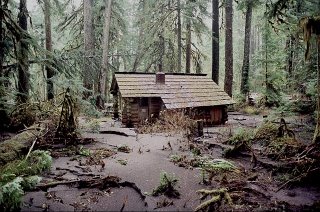 The NW corner of the park usually has its own share of flood related damage each year. And though it's not unusual for there to be Carbon River inspired washouts, this rainstorm brought substantially more destruction to the area. For example, here is the idyllic Ipsut Creek Cabin. It suffered heavily during the flood. Is it me, or does this place remind you of Yoda's house on Dagoba?
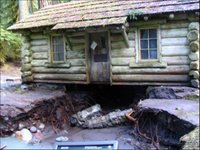 This creek diversion gives literal meaning to the name, Ipsut Creek Cabin. If Yoda did live here, he'd have to use quite a bit of "the force" to fix things.
 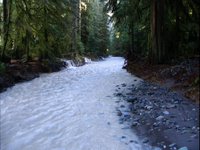 As for the Carbon River Road, more than two miles of it washed away in at least four separate spots. In some places, the river flowed down the middle of the road (like here). For climbers, this could spell delay in early season attempts of Liberty Ridge.