Some how I am not surprised that the same discussions ingear choiceswe had in the'70s are the same discussions we are having today. Frozen feet and frost bite in single boots have brought us the warmestdouble boots ever made. But may be not the best double boots ever made. High tech clothing, insulation and fabrics are exceptional now . But the designs and products you can buy off the shelf may not be the best designs for climbing. Designs intentionally must do multi tasking as ski, snowboarding and climbing clothing."Climbing designs" being the last in line generally as the smallest consumer group.
Long gone are the days when most serious climbers owned a sewing machine and actually knew how to use it!
Tasker and Renshaw did a number of first British and first British winter ascents in the Alps from the mid '70s on. Including a winter ascent of the Eiger in 1975. There were others that were just asimpressive at the time asthe Eiger. Both went on to succeed on bigger climbs. The climbs are the same.Our gear has gotten better. I would be hard pressed to say we as climbers have gotten better. Certainly our imaginations have grownas have our capabilities.
A lot has changed in alpine climbing over the last 35 years. Including the weather. It is generally warmer. But much of the basic challenge has stayed the same as well, which is why winter alpine climbingstill interests me..
This article is from the August/September 1975issue of MOUNTAIN LIFE.
 Jonathon Griffith photo @ http://www.alpineexposures.com/
One Man's Gear
by Joe Tasker (1948-1982)
"Are you taking your long-johns?"
The author of the "Wall in Winter", an account of his seven-day epic on the Eigerwand with Dick Renshaw, featured in MOUNTAIN LIFE 20, will need no introduction to readers. Here Joe Tasker presents his own personal likes and dislikes in Alpine equipment.
Even after years of practice I still find that before an Alpine route the same questions about clothing and equipment get asked: 'Are you taking your "long-johns"?'
'No, I've got my overtrousers. They'll do just as well. How many jerseys have you got?'
'Just one spare.'
And so it goes on, the ceaseless evaluation of weight against eventuality; the number of krabs and pegs estimated in accordance with the difficulty of the climb and then whittled down to a manageable load. Each time it all needs rethinking and there is no guarantee that one has chosen the right combination and amount of clothing and equipment until one is back safely off the mountain. But some things can be seen to be more useful and better suited to Alpine climbing than items of clothing and equipment currently in use. One of the most awkward pieces of clothing that many people wear are those much praised thick, woollen breeches [I think Americans call them knickers]. They are meant to be warm even when wet, but in practice they tend to be too warm and uncomfortable when it is hot, and when it is cold the snow sticks to the wool, melts from the body warmth and freezes into an icy armour-plating, stiff to walk or move in and storing up moisture to melt later in the warmer surroundings of a hut or bivouac. Much more sensible - but much more expensive and not readily available - is a salopette. This is a chest-high trouser with sewn-in braces; for climbing the leg of the salopette ends low down on the calf and for skiing it is ankle-length. The design is excellent; the height of the 'waist' virtually eliminates the cold spots which can develop there from jersey and shirt getting separated from breeches. The length of the leg cuts out the cold spot below the knee where gaiters and breeches often part. On top of that the material dries readily if it does get damp and consequently does not freeze solid. The material is a stretch fabric, not completely waterproof but, more importantly, snow does not adhere to it. Skiers have been used to much more sensible material for dealing with snow for years but I wouldn't recommend rushing out and buying a climbing salopette derived from the ski salopette, even if you can find any on sale. They were retailing last year in Chamonix at £27 per pair!
As with so many articles of clothing the salopette can be readily made from materials obtainable in many big stores or by mail order. It only requires a bit of patience and a few hours with a sewing machine.
It is difficult, however, to compromise on footwear. Even for summer climbing in the Alps double boots seem to be the best thing. This may simply be a reflection of the sort of climbs that Dick Renshaw and myself have been doing over the last few years, but we have done some hard rock routes in 'doubles' too - such as the Walker Spur and the Bonatti/Gobbi route on the Eckpfeiler. At first it wasn't through choice that we climbed such routes in doubles but because they were the only boots we had. Although such routes were quite trying in doubles the boots came into their own on mixed climbs. We rarely experienced cold feet on stances and once survived a whole night on the Dent Blanche North Face standing up on a step cut in the ice, unable even to take our crampons off, never mind slacken our boots (as the books advise). Although we had to wiggle our toes to make sure they were still there we never had the slightest trace of frost-bite afterwards.
Except for the Galibier Hivernales, most double boots seem similar in their warmth-retaining properties and clumsiness; my own are Harlin Leroux, which don't seem to be made anymore. There isn't a lot one can say about krabs, nuts, slings and pegs, except that we British climbers seem to take far too many. Perhaps this is due to the habit of taking meticulous care to protect pitches on a British climb - a precaution which is out of place in the Alps, where protection is usually more straightforward and must be more rapidly arranged. Some of the 'super-strong' krabs on the market today seem to be too fat for ease of manipulation in awkwardly-placed pegs or where one wants to slip a piece of line or tape through the eye of the peg. I do not really think that there is any one set of equipment that is the answer; it depends on what you grow accustomed to. Of the various models of curved pick axes available Dick and I have been using Chouinard axes and hammers. At the time we got them there were few others available. In summer the combination of axe and hammer curved picking' seemed to work well, though Dick was justifiably apprehensive of his axe after the tip broke off on a winter climb in Scotland - an eventuality one dare not contemplate on a big ice route like the North Face of the Droites. When the ice is very hard, though, as it can be in winter, the Chouinard hammer is very unsatisfactory - the shaft being too short. This causes poor purchase in the ice due to the limited arc of swing and also damages the knuckles, even through Dachstein mitts. In very hard ice we were often making a Terrordactyl-type insertion movement, and that sort of axe/hammer might be more efficient on certain ground - but against that would have to be weighed its disadvantages on more general ground.
On the question of crampons I am undecided. I climbed a lot in a pair of Salewa adjustables which someone described as 'bent tin' and another lad, whose gear hadn't arrived in Chamonix, declined my offer to loan them to him until I said that they had taken me that year - amongst other climbs - up the North Face of the Eiger, Dent Blanche and Eckpfeiler. I didn't see them again for another six months and was consequently forced to buy another pair. I chose the Chouinards but didn't find myself on really difficult ground in them until a year later. Meanwhile Dick had used his on various hard climbs and was visibly startled one day on the camp-site when doing the ritual sharpening of the points to find fracture lines across both crampons; they subsequently came apart in his hands. A couple of weeks beforehand he had been on the North Face of the Col de Peuterey. They fractures must have occurred then.
It constantly surprises me to think of how much crampons do put up with and that the front points don't just buckle up.
As far as performance goes the 'bent tin' Salewa crampons seemed perfectly satisfactory, but I did feel that Dick had the advantage over me on the North Face of the Eckpfeiler, when we were climbing very steep ice for about 1500 feet and he was wearing the Chouinards. They do give very good support for front-pointing but after one or two unnerving moments on difficult mixed ground I've never really felt at home in Chouinard crampons where there is rock around. The more flexible crampon seems to mould itself to the contours of the rock and hold better.
The sharpening of crampon points is overdone in the Alps. When you think of how much rough ground you often cover before meeting the real difficulties of a climb it is quite clear that all the effort put into sharpening them - and quite a bit of steel - is lost. I felt the points of my crampons at the foot of the Eckpfeiler; they had been razor-sharp to start with but were more blunt than they had ever been - and that was just with the descent from the Trident bivouac hut, and Col Moore! I don't think the same holds true for axe and hammer.
The drive-in/screw-out ice screw is the most useful ice peg around. The oddly-shaped Salewa-type, however, tends to hold too well in very hard ice. It can take far too long to extract and precious time is wasted hacking it free from the ice or riskingmaking it unusable by warping or even snapping it while it is still tight. A much more manageable drive-in/screw-out is the Simond-type,which has a round, slightly tapering shaft with a fine thread. It seems to hold well and is extracted with a minimum of effort. However, in some ice the Salewa does hold better.
Finally a word about food. Sometimes our food seems to weigh a bit heavy but at least we know that what we have got is nourishing. Over several seasons we have evolved a bivouac menu that has nothing to do with dehydrated foods and soups - which seem to be the standby for many teams. Quite apart from any considerations as to whether there is actually any food value in the dehdrated stuff, it takes too much heating and cooking.
For soup we take bouillon cubes - a continental equivalent of Oxo - in various flavours. This is a meat extract, very tasty, and replaces a lot of the salt lost in the day's exertions. It only needs to be put into hot water and it's ready.Into that you can put polenta, a ground corn, easily obtainable abroad and far more nutritious than powdered potato (Hiebeler survived several days in winter living solely on heated-up polenta. You can also buy fairly cheaply big, fatty lumps of meat to cut up into the bouillon. This makes the 'soup' into a tasty concoction of real value.
These comments are not meant to be definitive but might suggest new possibilities and improvements. The End!
More here on Taker and Renshaw:
http://reference.findtarget.com/search/Joe%20Tasker/
http://en.wikipedia.org/wiki/Joe_Tasker
http://cc.bingj.com/cache.aspx?q=dick+renshaw&d=5037361146364964&mkt=en-US&setlang=en-US&w=54fd9b70,895d08b0
I'd like to thank IAN PARSONS for tracking down this article for me and making the effort to email it from England to the far side of the USA. The effort is much appreciated!


 Ring of Steall, 8c+, Steall Crag, Glen Nevis. Photos by Claire MacLeod. Click on the pics for a bigger view.
 The crux Egyptian of Ring of Steall
 Two hikers suffering from hypothermia and frostbite were airlifted from Camp Muir on Mount Rainier at 6:15 this morning, with the help of a Chinook helicopter operated by members of the Army Reserve’s 159th Aviation Regiment at Fort Lewis. They were taken to Madigan Hospital and from there by ground transportation to Harborview Medical Center in Seattle.

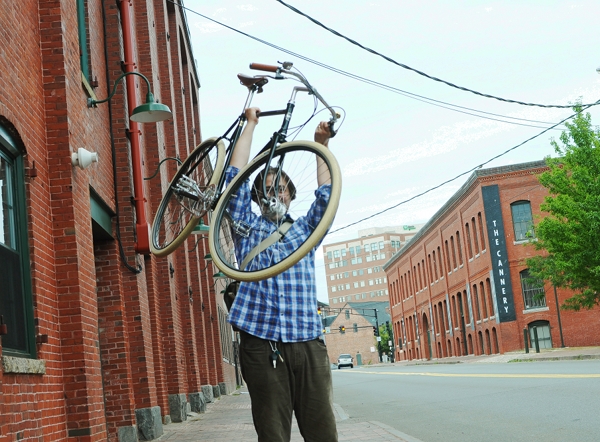 When borrowing bikes from Portland Velocipede, I had thought the Co-Habitant might like to try something entirely new, like a Gazelle or a Brompton. But he is a die-hard Pashley fan and seized the opportunity to ride the Pashley Guv'nor.The man is not overly fond of writing, so I will do my best to communicate his impressions - though the picture above pretty much says it all.
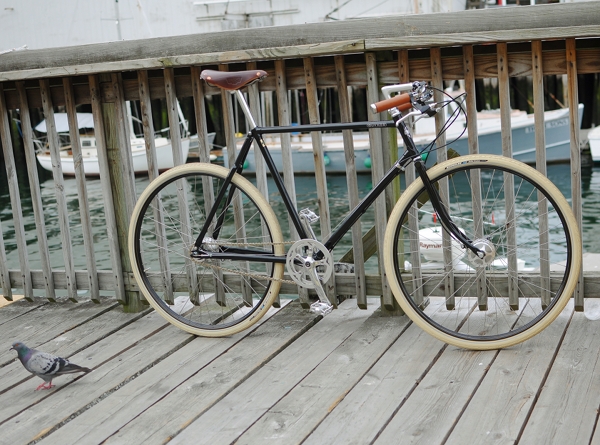 The Pashley Guv'nor is modeled on the 1930s Path Racer, and its faithfulness to this concept is remarkable. The frame is relaxed, with the same frame geometry and 28" wheel size as the Pashley Roadster. But while the Roadster is made of high-tensile steel (heavy, utilitarian), the Guv'nor is made of Reynold's 531 tubing (super light, high-end).
 Additionally, the Guv'nor features fancier lugwork, and is equipped with sportier and more luxurious components - such as the racy upside down "North Rroad" handlebars, a Nitto stem, leather grips, and a Brooks B17 Titanium saddle. It is available as a single speed or a 3-speed, and a crazy limited edition with 4 speeds and golden lugs exists as well.
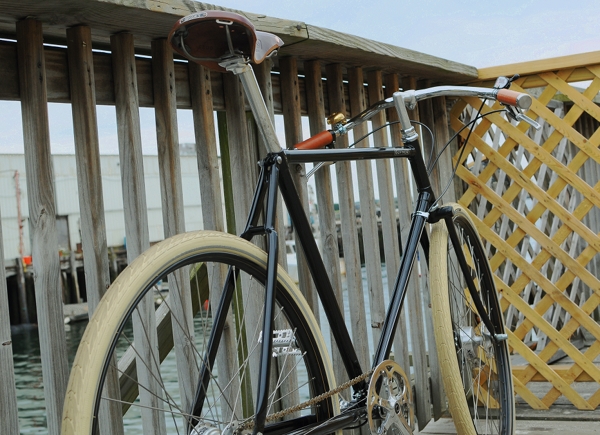 The Guv'nor is fitted with cream Schwalbe Delta Cruiser tires, and it intentionally lacks fenders. No lights or racks either. Like a traditional path racer, this bicycle has a high bottom bracket and horizontal chain stays. Because of the high bottom bracket and theslack seat tube, there is a huge amount of seat post showing, which exaggerates the aggressive appearance. Although the Co-Habitant's Roadster has the same amount of exposed seat tube, this is disguised by the huge rails and springs of the Brooks B-33 saddle that the Roadster is fitted with. The flat and unsprung B17 on the Guv'nor, on the other hand, leavesevery millimeter exposed.
 Front and rear drum brakes give the bicycle a clean appaerance.
 They also allow for black rims with golden pinstriping (not really captured in the pictures, but it's there).
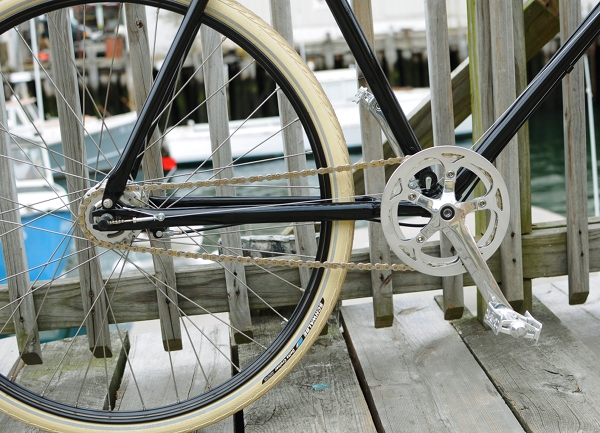 Drivetrain and track fork ends. The one aspect of the Guv'nor's components the Co-Habitamt dislikes are the cranks; he thinks they are "ugly" - though personally, I do not think they are bad looking.
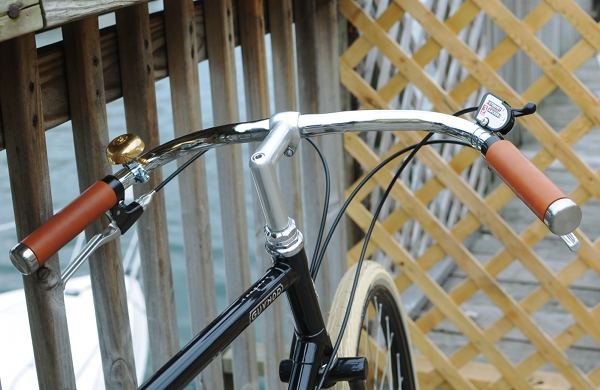 Close-up of the handlebars, with brass bell and retro-style Sturmey Archer 3-speed shifter.
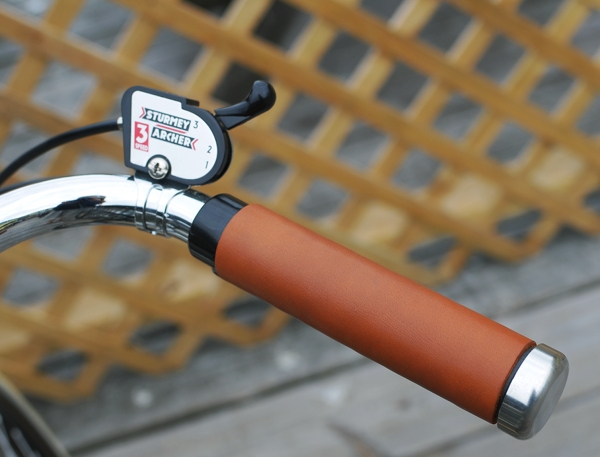 The vintage-looking shifter is a nice touch.
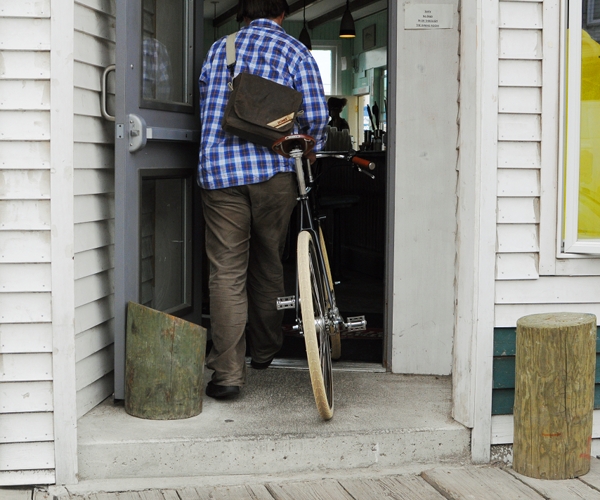 As I didon the Abici, the Co-Habitant rode around Portland, Maine on the Guv'nor - even taking it along into a dining establishment. No one seemed to mind and the bicycle received compliments.
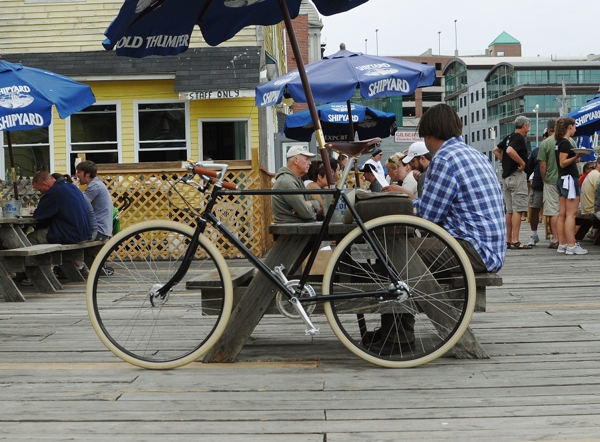 The Pashley Guv'nor, waiting for hisbeer and calamari.Unlike the Pashley Roadtser, it is extremely easy to maneuver and drag around due to its light weight.
 In terms of ride quality, the Guv'nor handles like a cross between a roadster and a road bike. It is very light, fast, and maneuverable - yet also stately. Some aspects of the geometry can take getting used to: Because the saddle is so far back due to the slack seat tube (plus the seat post has set-back), the handlebars are extremely far away. The Co-Habitant thinks that Pashley should have either used a shorter stem, or a seat post with no set-back; otherwise the posture feels too extreme - especially in combination with the slack seat tube and the forward position of the pedals.
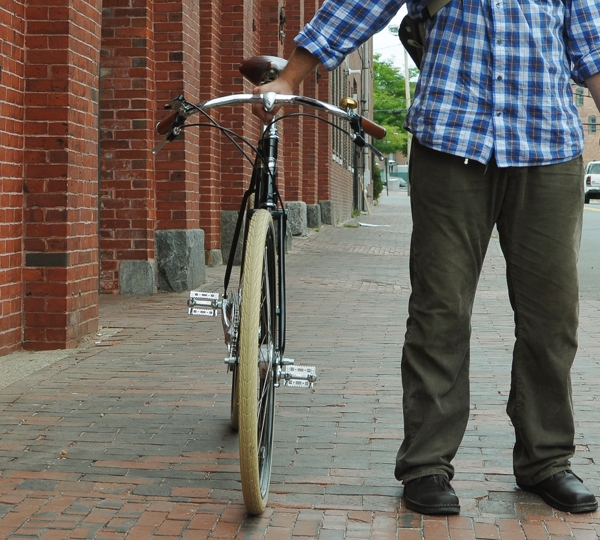 Riding the bike around town was tremendous fun for the Co-Habitant, and of course he would love to own such a bike in a world unhindered by practical considerations. But the Guv'nor woud hardly be a reasonable choice for regular commuting, given its lack of fenders and lights. And while in theory, these could be installed, doing so would ruin the authentic Path Racer look - which is the very heart of the concept behind the Guv'nor. Ultimately, theGuv'norwas not designed for practicality and makes no claims to be a daily commuter. It is a trophy-bike, meantto be taken out in fair weather and enjoyed for its unique ride quality and vintage aesthetics. More than anything, it is the concept itself that is impressive: Pashleycreated this bicycle true to the original and made it painfully handsome in the process.
 Recently our friends called when their old Ford pickup caught on fire at the local Walmart. It was quite and experience for them. Hubby went took our hay trailer down and hauled it back to the house.


 Rialto Beach, Olympic National Park, WashingtonSeptember 10, ..
 I always loved Georgetown. I remember going for the first time with my parents when I was about 8 or 9 years old and marveling at the hippies, boys and girls strolling down the sidewalks with their bare feet and guitars, the lava lamps in the gift store windows, and the psychedelic poster shops. I still have my
 G.U. had the most beautiful campus with its medieval looking buildings and courtyards. In between college semesters I worked at the university hospital while punk rock was slowly taking the city by storm. You could go to Haagen-Dasz Ice Cream and talk to a slightly goofy Henry Garfield behind the scoop counter before he joined Black Flag as "Henry Rollins" to became a professional angry guy.

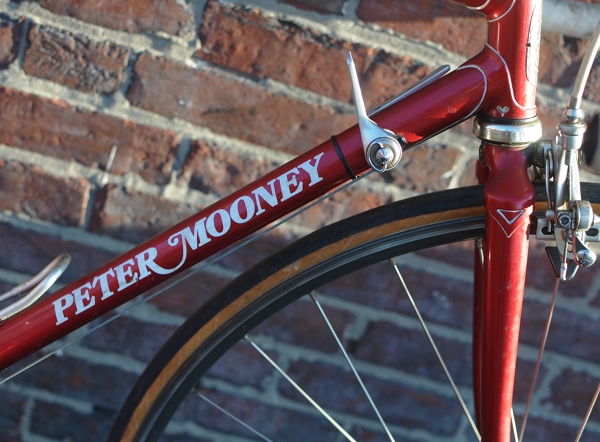 As a (somewhat) reasonable person, I recognise that sometimes a deal is just not for me, no matter how good it is. But I can still feel disappointed, can't I? Peter Mooney is a famed local framebuilder who has been making custom bicycles since the 1970s, including his own lugwork. I love his frames and very much hope to have one of my own some day. And for a brief, dazzling moment, it seemed that such a day might come much, much sooner than I expected.
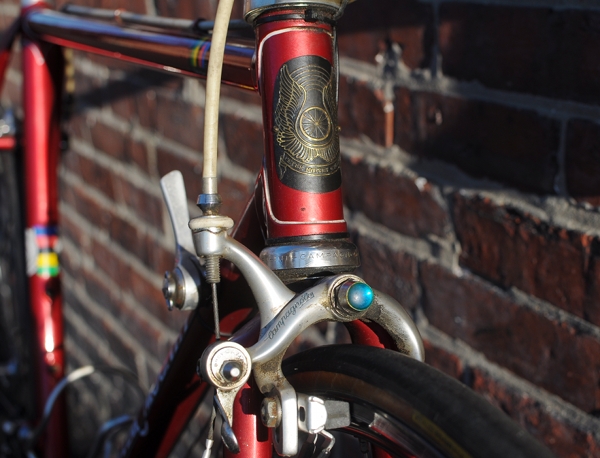 As usual, these things have a way of finding me when I am not looking, and in this case the "thing" was a second hand Peter Mooney bicycle. As soon as I learned of the bike's existence and availability, I was ready to bargain and prepared to sell or trade my other vintage roadbikes in order to get it. Going by the description, it seemed that the frame was my size - so it was only a matter of seeing it in person and test riding it.
 But the stars were not aligned in my favour. Although the bicycle does not look allthat small in the pictures (compare it to my Moser), it felt very small once I tried to ride it. The size is 50cm (center of the bottom bracket to toptube), which is only 2cm smaller than the size I normally ride - so maybe there was something additional in the proportions that didn't feel right to me. Not sure what it could be, because the top tube actually seems long-ish, and the stem is long as well. Does anything unusual jump out at you, looking at this frame?
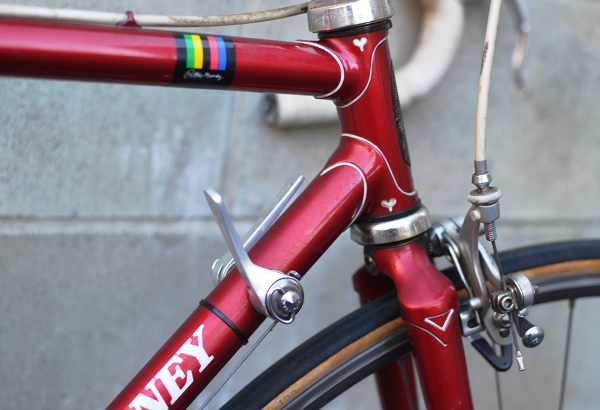 And I guess that is just the thing with a custom-built frame: It was custom-built for someoneelse,which is bound to make second-hand purchases tricky. And the fact that it was built for someone else (judging by the components, most likely in the mid-1980s?) also makes me wonder what is the story of this bicycle - why did the previous owner give it up?
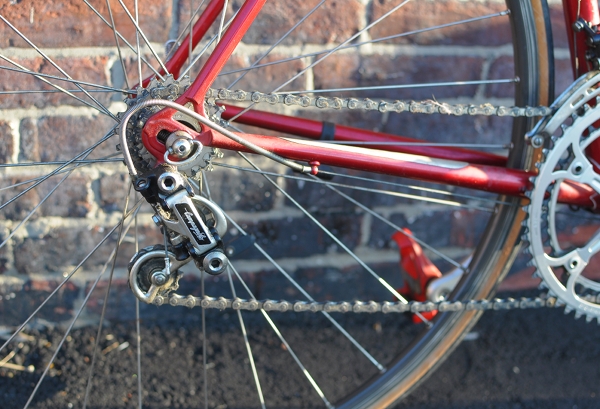 The bicycle certainly has nice components - Campagnolo everything. And though it was clearly ridden, it looks to have been well maintained.
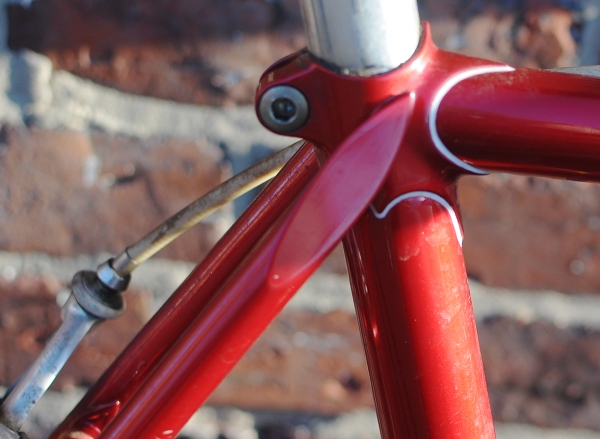 The elegant seat cluster with the white outlining is my favourite part of the lugwork. I hope the original owner appreciated it as well.
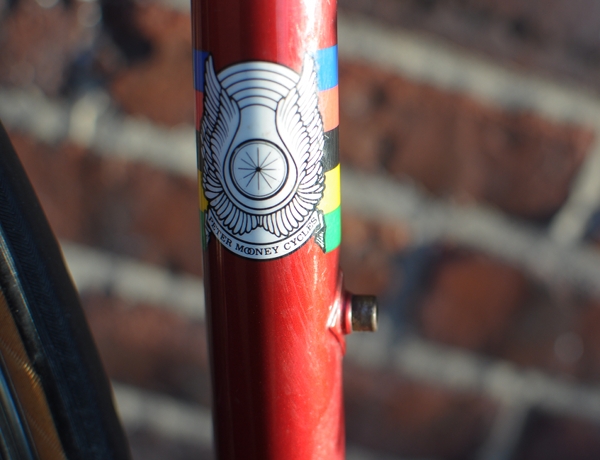 Who knows, maybe some years from now I will have a Peter Mooney bicycle of my own - in my size, in my favourite colour, and maybe even with custom lugwork (let's just say that I already have sketches for the lugwork!). But with this particular bike, I am glad that I was able to resist. It's a bad idea to get a bicycle that doesn't fit you, no matter how good of a deal it is.
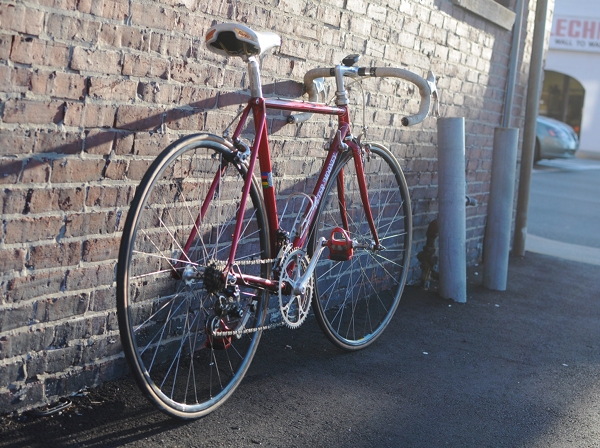 If you are between 5'3" and 5'6" and are interested in this bicycle - it is in the custody of Vin at Old Roads, whose contact information you can find here. For the right person, it is a rare chance to own a bicycle by one of the great framebuilders. But what are your thoughts on getting a custom bike second-hand? I imagine that the more unique the original owner's anatomy, the more difficult it would be to find a new home. I wonder how many custom bikes get second chances, and what are the circumstances under which they switch owners.
