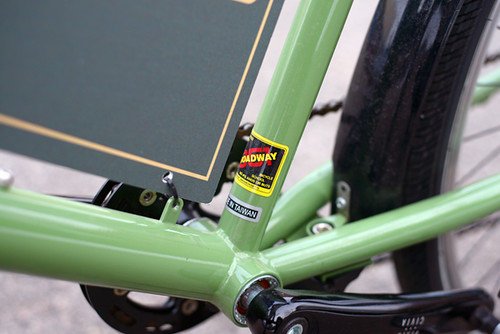
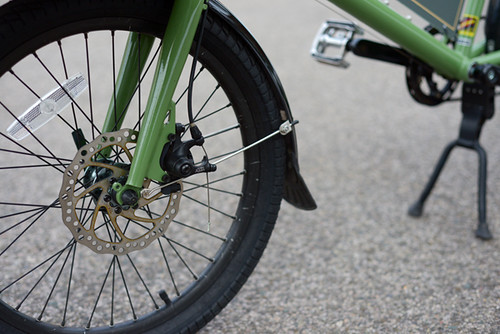
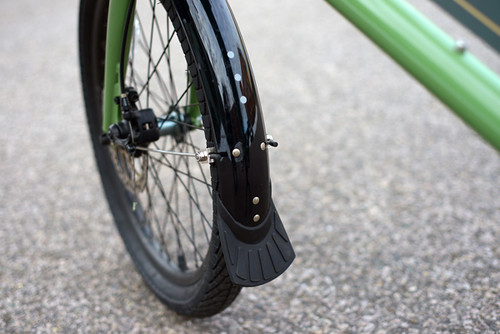
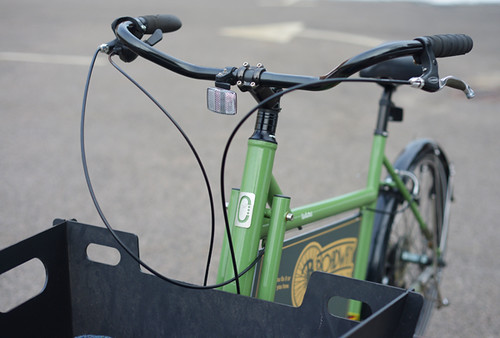
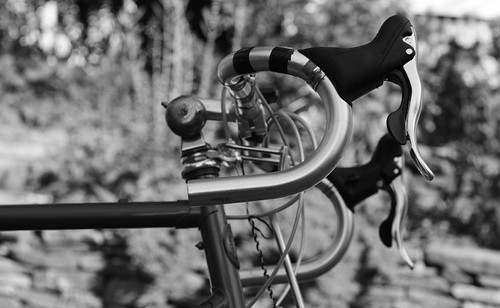
 File this under "duh" if you will, but I need to acknowledge this out of fairness to Rivendell, and as a means of providing information to others wondering just how much of an effect one's positioning on a bike can have on pedaling effort and speed. Earlier I described being considerably faster, particularly uphill, on the Seven bicycle I have on loan in comparison to my Rivendell Sam Hillborne. It was widely agreed that there were many factors involved in this difference - from frame geometry, to weight, to positioning. For some time now I'd been considering making changes to my Rivendell, and finally it's been done - thus somewhat leveling the playing field between the two bikes, with interesting results.
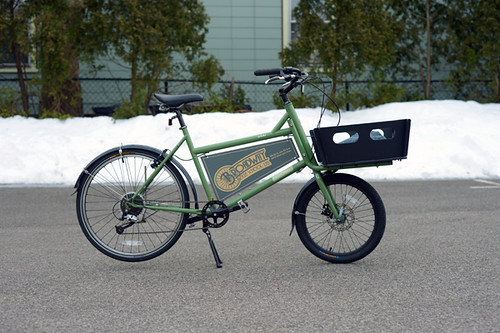
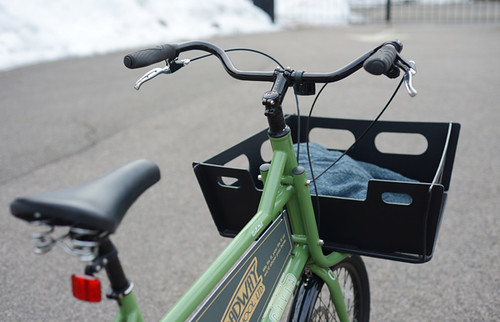
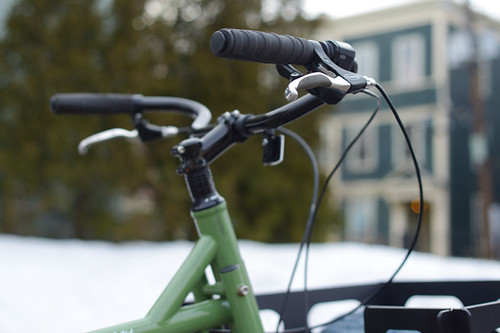
You may spot a number of other alterations in these pictures, but for now I will talk just about the difference in positioning. Namely, the bike now has a longer stem (8 cm, instead of 6 cm as previously). The handlebars have been positioned slightly lower as well.
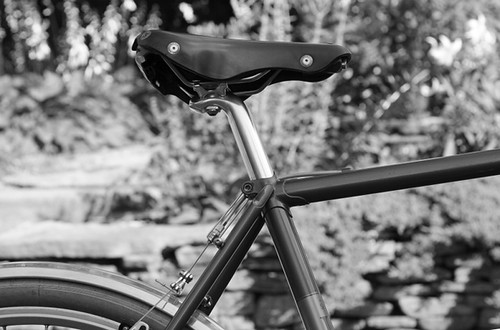 We've also reduced the amount of setback on the saddle by about 2 cm (not just by moving the saddle forward, but by replacing the seatpost). The overall effect is that my lean has increased by a small amount, my weight on the bike has shifted forward, and my hips are move directly above the cranks.
It's important to stress that I would not have found this position comfortable a year ago, so making these changes is not so much "admitting a mistake," as altering the bicycle's set-up to reflect my changing skill level and preferences. I very much find this position comfortable now - comfortable and fast.
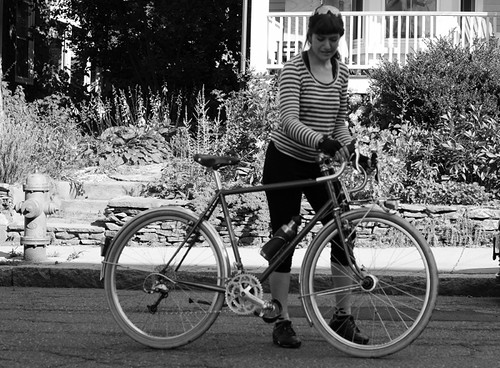 We rode to Lexington, MA to try some hill intervals. I did not attach a saddlebag, so that I could get a sense of how the bike itself performs. And it performed well - albeit differently from the Seven.
Here is my amateur description of what happens on the two bikes when I cycle uphill: The Seven allows me to very easily "attack" a hill - to cycle up it at a fairly high speed, until I run out of steam toward the end and am forced to slow down. In comparison, the Rivendell does not like to "attack" and forces me to slow down earlier. In its previous state, this slowing down happened almost immediately and drastically. Now it happens half way up, and the speed drop is considerably smaller. Cycling on flats, the new positioning makes the Rivendellfaster to accelerate than previously. Not as fast as a racing bike of course, but I no longer feel as if I am sitting "behind the bike" unable use my weight efficiently.
Once I attach bags, that will no doubt slow it down some. But I have a strong feeling that the change in performance is due to the forward placement of my weight more than anything else - when I ride the bike now it feels inherently different - more responsive and more efficient. I am not trying to convert the Rivendell to a Seven and I am not considering taking it on paceline rides. I want to keep the wide tires, the fenders, the rack, the bags, the lighting - there is no compromise possible on that end, as these features are extremely useful to me. But the Seven's positioning (and my enjoyment of that positioning) has most definitely affected my expectations in terms of performance, and I don't think I can go back to short stems and seatposts with generous setback. Not that there is any reason I should - It's all about what you are comfortable with at any given point in time.


 Upon entering Kootenay National Park at Radium Hot Springs, the sun was shining once again. This view of the Kootenay Valley is about half-way through the park. (Please, double-click on the images to view a larger version.)
 This is half of Two Jack Lake, near Banff, taken between rain showers. I think it is the west half but my sense of direction got totally confused with the drive up there! At Two Jack Lake there is a lakeside campground and then there is the other one. The former was full but there was plenty of sites available at the other one, which is where I spent my second night in Canada.


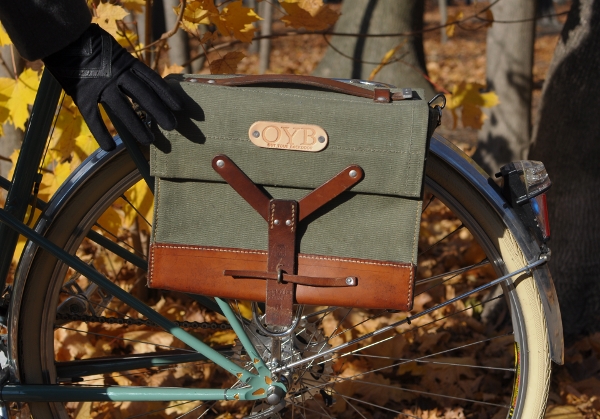 The OYB Pannier is a small Swiss army surplus bag, modified via the addition of rack attachments and other features byJeff Potter - the owner and author of the project Out Your Backdoor ("indie outdoor lore and more"). I purchased this bag asa smaller alternative to the enormous shopper pannier I normally use. My criteria were durability, classic aesthetics, a trustworthy attachment system, a reasonable price, and a size just large enough to snugly fit my medium format camera equipment or my (very small) laptop.While I am aware that these same bags (without the bike-ready modifications) can be purchased from several other sources, I opted for the OYB version because I wanted the modifications to be made by someone with experience and because I wanted to support the "Out Your Backdoor" project, which provides some great resources for its readers.
 Compact and boxy, the pannier is a Swiss military bag made of a thick, stiff, olive-green waxed canvas with brown leather trim and steel rivets. The OYB leather patch is a lighter shade than the rest of the leather on the bag, but this can easily be changed with a modest application of neatsfoot oil or even Proofide.I am not sure whether this particular bag started out as new-old-stock, or whether it had been used in its previous life, but to me it looks more like the former. The condition is better than I had expected based on the pictures and product description on OYB.
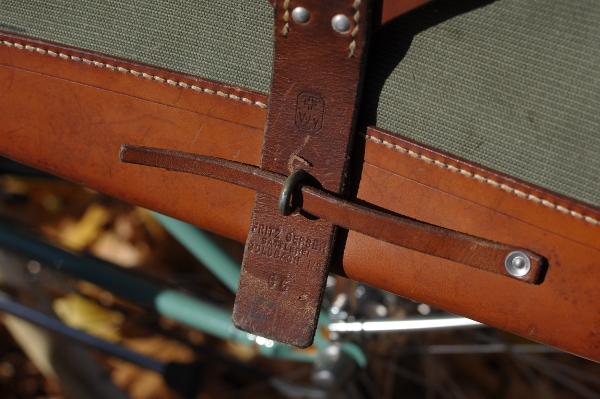 The closure system is simple and secure: That very stiff leather cord pulls out of the metal loop, and the thick leather strap lifts up off the loop to open the bag. For those curious, the imprint on the leather reads "Fritz Gerber Sattlerei, Goldbach."
 The attachment system is a combination of metal hooks and bungee cords, with which the pannier is secured to the rear rack.The rack I have on this bicycle is theConstructeurrack fromVelo Orange, which is quite small.
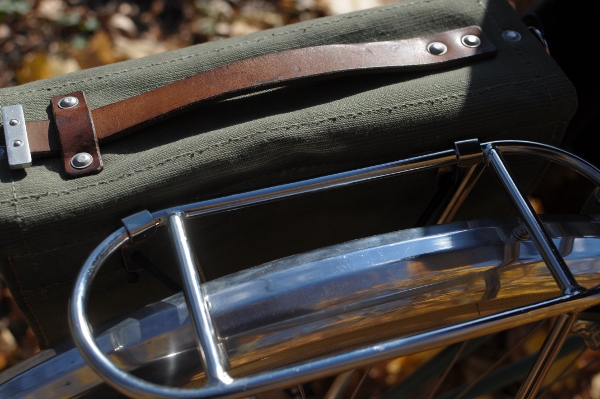 Here is a close-up of the metal hooks. They are riveted on to the bag.
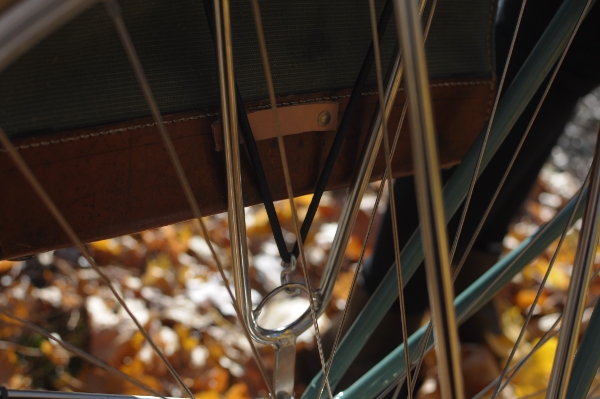 And here is a close-up of the bungee attachment. Together, these two attachment points ensure that the pannier does not sway or bounce against the rack - a good feature when you are planning to carry camera equipment. When the bag is not being used as a pannier, the bungee hook attaches to that small leather strip you see on the back of the bag - so that it does not hang loose. [Edited to add: I am now told that the bungee cord is supposed to go through that leather loop before you hook it to the bottom of the rack - oops.]
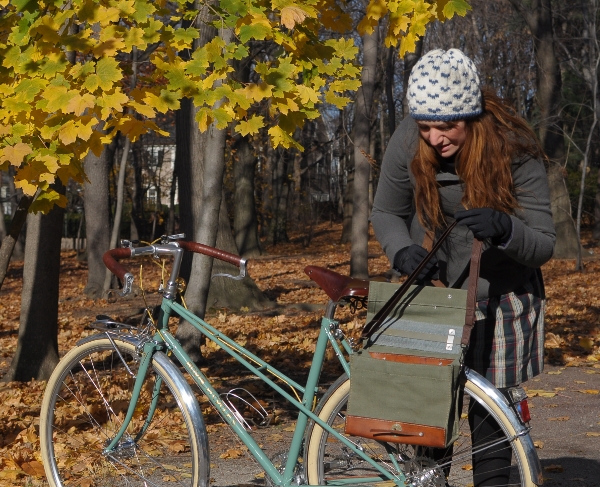 In addition to the rack attachments, the OYB pannier can be ordered with a number of other optional features, including shoulder strap attachments with a removable shoulder strap. I asked for the strap, because I pan to carry the bag around when off the bike, and this set-up essentially this gives me a camera bag and pannier in one. Other options include lights mounts, and a variety of other attachments.
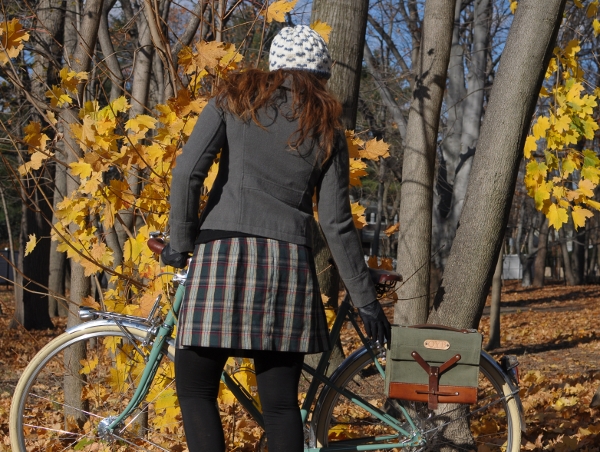 To give you a sense of scale, here is the pannier in relation to me and to the entire bike. It is a small bag. Dimensions are listed as:8.5" tall, 4" deep, 11.25" wide (5.4 liters). Inside, the length of the bag is listed at 10.75", but I was hoping against hope that it would fit my laptop. OYB gives instructions for stretching the bag out with magazines in order to make it fititems of that size, and I will give this a try.If I can get my laptop to fit, I will be thrilled - but I am not getting my hopes upand am prepared to content myself with this being a camera bag only.
 If it were not for the laptop fit issue, this would pretty much be my dream pannier. The mil-spec colour scheme is not for everyone, but I love it, and it suits almost all of my bikes nicely. The durability of military surplus items is superb, and I appreciated getting the bag customised by Jeff atOYB. This is a classic, versatile, and reliable little pannier refashioned by someone who loves bicycles.
 Of all of the family pictures in Mom's albums, this is the only one I found that was taken outside during the winter. It was the winter of 1964 and shows me and my little sister. It looks like I lost my foot, or at the very least, my boot! The houses in the background belong to the neighbors.
 An early spring snowfall at our house at Karen Kove, north of Columbia City, March ...
 My front porch. December ... It almost looks like this today. New fallen snow is pretty, even, dare I say, beautiful. That is, unless, like today, I had to go somewhere. Yesterday we got about 8" of the fluffy white stuff, which, considering conditions elsewhere, isn't all that much. But the wind was blowing too. I certainly didn't enjoy driving this morning on the slippery, snow-packed roads in below zero temperatures (with a -25°F wind chill). Brr.